
 ultimate-guide
Corporate Travel Logistics Best Practices: 2026 Guide
Table of Contents
- What Corporate Travel Logistics Best Practices Actually Cover
- Corporate Travel Policy Best Practices That Prevent Last-Minute Chaos
- Executive Ground Transportation Charlotte NC: What to Lock Down First
- CLT Airport Corporate Transfer Services: Booking, Backup, and Contingency
- Group and Multi-Stop Logistics for Corporate Events
- Common Mistakes in Corporate Travel Logistics and How to Avoid Them
- Frequently Asked Questions
Last Updated: September 14, 2026
What Corporate Travel Logistics Best Practices Actually Cover
Corporate travel logistics best practices cover every decision that moves an employee from doorstep to meeting room and back without friction: policy design, booking controls, ground transportation, flight monitoring, group coordination, and contingency planning. Get those six elements right and the rest of the trip tends to take care of itself.
This guide from CLT BLK Truck breaks down what actually works, based on what we see moving executives through Charlotte Douglas International Airport every week. Below, we'll show you exactly how to structure policy, lock down ground transportation, and build backup plans that hold up when flights slip.
The biggest mistake companies make is treating logistics as a booking problem. It isn't. It's a risk-management problem with a scheduling component.
Corporate Travel Policy Best Practices That Prevent Last-Minute Chaos
The most effective corporate travel policy best practices share one trait: they remove decisions from the traveler's plate before the trip starts. A policy that requires judgment calls at 6 a.m. on a travel day will fail.
Start with three fixed rules:
- Booking windows. Require flights and ground transportation to be booked at least 72 hours out, with a defined same-day exception process (Reducing the cost of government travel by encouraging earlier travel booking).
- Approved ground vendors. Pre-approve transportation providers so travelers aren't comparing apps at the curb.
- One point of contact. Every trip gets a single coordinator who owns changes, not a shared inbox.
What most guides miss is the escalation path. A policy without a named backup contact is just a document. Define who travelers call when a flight cancels at 11 p.m., and make sure that person can actually rebook.
Executive Ground Transportation Charlotte NC: What to Lock Down First
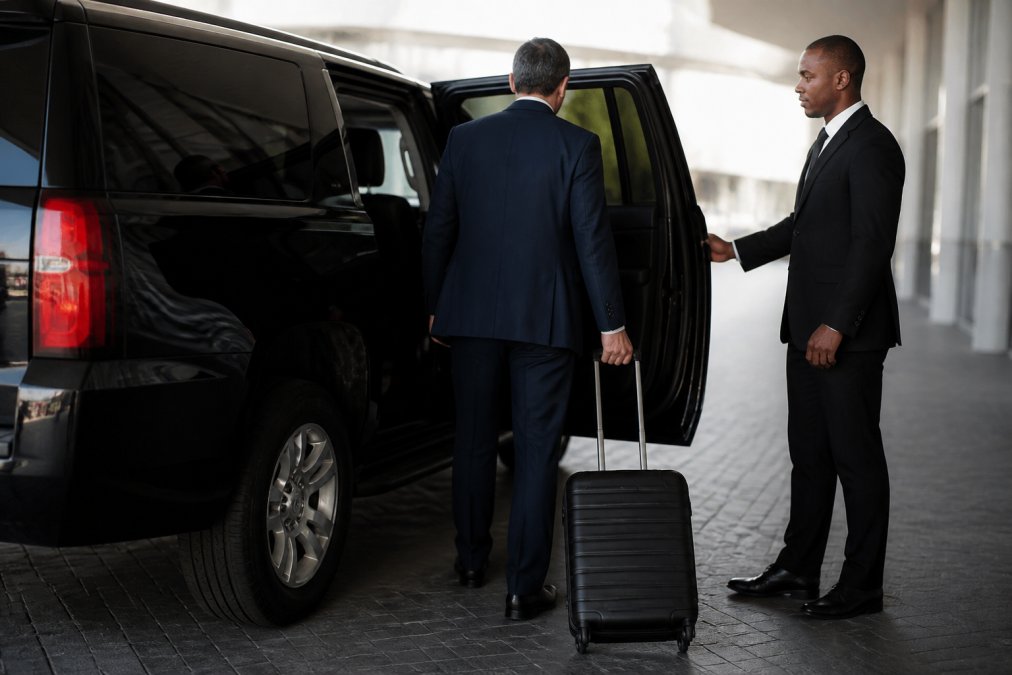
Executive ground transportation in Charlotte NC should be confirmed before flights, not after. Ground transport is the least flexible part of the trip: a delayed flight can be rebooked, but a missing vehicle at the curb has no substitute at 7 a.m.
Lock down three things first: the pickup time relative to arrival, the vehicle capacity against actual luggage, and the cancellation terms. For groups, confirm seating and cargo space in writing. A vehicle that seats six passengers comfortably may not hold six passengers plus golf bags or trade-show materials.

Booking by phone or text matters more than most coordinators expect. When a schedule shifts, a text thread resolves faster than a web form. CLT BLK Truck handles corporate bookings this way, with 24/7 availability and flight monitoring built into every airport transfer.
Flight Monitoring and Buffer Time at Charlotte Douglas International Airport
Flight monitoring means the transportation provider tracks your flight in real time and adjusts pickup automatically when it lands early or late. Without it, the traveler absorbs the delay and the driver waits on a guess.
Buffer time at Charlotte Douglas International Airport deserves its own rule. Build in time for deplaning, baggage claim, and the walk to the pickup zone. For departures, work backward from the boarding time, not the departure time, and add a cushion for security lines.
CLT Airport Corporate Transfer Services: Booking, Backup, and Contingency
CLT airport corporate transfer services should be evaluated on three criteria: booking reliability, backup capacity, and contingency handling. Reliability is the baseline. Backup and contingency are what separate a vendor from a partner.
Ask any provider three questions before you sign:
- What happens if the assigned driver is unavailable?
- How do you confirm a same-day booking?
- Who do I reach if the vehicle breaks down?
A provider without clear answers to all three is a risk you're absorbing.
| Scenario | What to Confirm Upfront | Why It Matters |
|---|---|---|
| Single executive, standard trip | Flight monitoring, pickup window | Prevents curb waiting |
| Group of 6-8 | Vehicle capacity, luggage space | Avoids split vehicles |
| Multi-stop itinerary | Hourly charter terms | Keeps schedule flexible |
| Same-day change | Backup driver availability | Protects the meeting |
| High-profile client | Discretion and privacy terms | Protects the relationship |
For Charlotte-based teams, a local operator with 24/7 dispatch covers more of these gaps than a national platform routing through a third party. CLT BLK Truck keeps vehicles and drivers in the Charlotte area, which shortens response time when plans change.
Group and Multi-Stop Logistics for Corporate Events
Group and multi-stop logistics for corporate events fail for one reason: capacity is planned for the ideal case, not the real one. Eight attendees become ten, and one vehicle becomes two.
Reserve Your Charlotte Ride Call, text, or request your trip online. Book Your Ride →
Plan group transportation around three numbers: total passengers, total luggage or equipment, and total stops. Then add a margin to each. For events with a fixed start time, book the vehicle to arrive early and stage nearby rather than circling.
Hourly charters work well for multi-stop days. The vehicle stays with the group, the driver waits between stops, and the schedule bends without a new booking each time. This is the format that suits client visits, site tours, and conference shuttles.
Common Mistakes in Corporate Travel Logistics and How to Avoid Them
The costliest mistakes in corporate travel logistics are process failures, not vendor failures. Most are preventable with a checklist and a named owner.
The most frequent errors:
- Booking ground transport last. Ground is the least flexible element and should be confirmed alongside flights.
- Ignoring luggage and equipment volume. Passenger count is not capacity. Golf bags, sample cases, and display materials all take space.
- No same-day process. Last-minute schedule changes are normal, not exceptional. Build the workflow before you need it.
- Treating privacy as optional. High-profile travelers need discretion confirmed in advance, not assumed.
- No single coordinator. Shared inboxes lose requests. One owner prevents dropped handoffs.
According to U.S. General Services Administration travel resources, structured pre-trip planning consistently reduces both cost overruns and traveler disruption. The same principle applies at company scale: the more decisions made before travel day, the fewer failures during it.
For teams that want a starting point, a simple pre-trip checklist covers most of the risk:
- Flights booked and confirmed
- Ground transportation confirmed with flight monitoring
- Vehicle capacity verified against passenger and luggage count
- Backup contact and escalation path shared with traveler
- Same-day change process documented
- Privacy requirements communicated to the provider
Corporate travel logistics rarely fail on the flight. They fail at the curb, in the gap between a delayed arrival and a vehicle that wasn't tracking it. Closing that gap is the whole job.
CLT BLK Truck handles the Charlotte end of that job with flight monitoring, 24/7 availability, hourly charters, and discreet executive service built for corporate schedules. With 500+ happy clients and a 5-star average rating, we've made punctuality the default rather than the exception. Get started with CLT BLK Truck and put your Charlotte ground transportation on a schedule you can actually rely on.
Frequently Asked Questions
What are the key components of corporate travel logistics?
Corporate travel logistics cover four areas: booking and policy controls, ground transportation, expense tracking, and contingency planning. Booking tools like Navan or TravelPerk handle flights and hotels, but ground transport is where most itineraries break down. Build in flight monitoring, buffer time, and a named backup vehicle for airport transfers. Document who approves exceptions, and keep a single itinerary accessible to travelers and coordinators. Companies that treat ground transport as a core logistics component, not an afterthought, see fewer missed meetings and lower stress on traveling teams.
How can companies improve their corporate travel policy?
Start with real data: pull six months of expense reports and identify where spend leaks. Then set clear pre-trip approval thresholds, require booking through the managed platform for flights and hotels, and add ground transportation as a policy line item with preferred providers. Navan enforces policy during booking, which removes the awkward post-trip conversation. Review the policy quarterly, and give travelers a simple way to flag when a rule doesn't work in practice. A policy that travelers can follow beats a strict one they route around.
What are the benefits of using professional black car services for corporate travel in Charlotte?
A professional black car service provides flight monitoring, a vetted chauffeur, and a guaranteed vehicle, which rideshare cannot promise. For executives arriving at Charlotte Douglas International Airport, that means the car adjusts when a flight is delayed and the driver is waiting at baggage claim, not circling. Corporate accounts also get consistent billing, hourly charter options for multi-stop days, and discretion for high-profile passengers. The trade-off is higher cost than rideshare, but for client-facing trips the reliability usually justifies it.
How do you manage ground transportation logistics for corporate events in Charlotte?
Treat event transportation as a timed operation. Map every pickup and drop-off, including hotel, venue, and airport, then assign vehicles by group size. For a golf outing or client dinner, book a mix of executive SUVs and larger group vehicles, and build in 15 to 20 minutes of buffer per leg. Use hourly charters when the schedule has multiple stops, so the driver stays with the group instead of re-dispatching. Confirm headcounts 48 hours out, and keep one coordinator reachable by phone or text for real-time changes.
What should be included in a corporate travel itinerary?
A working itinerary includes flight numbers and times, hotel address and confirmation, every ground transport pickup with driver contact, meeting locations with addresses, and a named internal contact for each day. Add passport or ID reminders for international trips and a note on local emergency numbers. For Charlotte trips, include the terminal and baggage claim meeting point at Charlotte Douglas International Airport. Share the itinerary with the traveler, the coordinator, and the ground transport provider so everyone works from the same schedule.
How does CLT BLK Truck support corporate travel logistics in Charlotte?
CLT BLK Truck handles Charlotte Douglas International Airport transfers with flight monitoring, hourly charters for multi-stop business days, and group transportation for corporate events. Booking is available 24/7 by phone or text, and the service includes executive amenities like Wi-Fi availability, phone charging, climate control, and complimentary water. For companies that need discreet, punctual ground transport for executives or small groups, a dedicated local provider removes the uncertainty of last-minute rideshare bookings and gives coordinators one number to call.
What happens if a corporate ground transportation provider cancels or the vehicle breaks down?
Reputable providers maintain a backup plan. Ask upfront how they handle vehicle failures, driver no-shows, and last-minute cancellations. A good answer includes a named backup vehicle, a dispatcher reachable 24/7, and a clear refund or rebooking policy. For airport transfers, the provider should also monitor your flight and adjust pickup automatically. When vetting a service, request their contingency process in writing. If they cannot describe it in specific terms, that is a sign the operation is too thin for corporate use.