
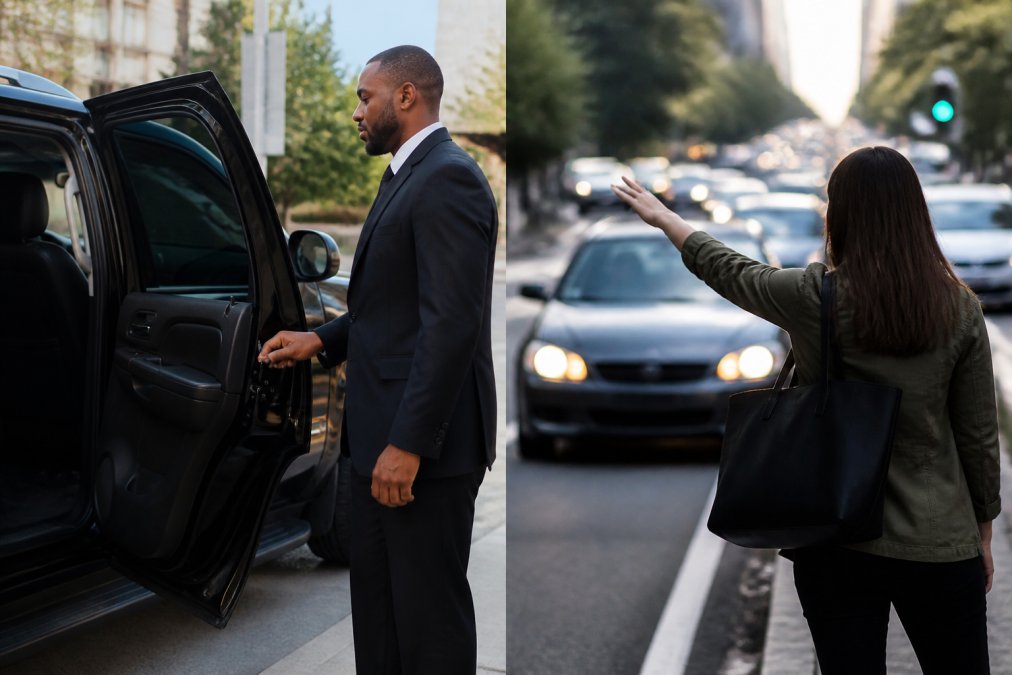
 comparison
Private Car Service vs Rideshare: Which Is Right for You?
Table of Contents
- Private Car Service vs Rideshare: A Head-to-Head Comparison
- Rideshare Surge Pricing Explained: What You're Actually Paying
- Airport Car Service vs Rideshare: Reliability When It Counts
- Benefits of Professional Car Service for Executives and Groups
- Insurance, Liability, and Driver Vetting: The Safety Gap
- Corporate Travel Expense Management and Accessibility
- When to Choose Private Car Service vs Rideshare
- Conclusion
Last Updated: August 16, 2026
Private Car Service vs Rideshare: A Head-to-Head Comparison
Choosing between private car service vs rideshare comes down to more than price. At CLT BLK Truck, we work with corporate executives, event planners, and frequent travelers every day, and the question we hear most often is simple: "Why not just use an app?" The honest answer is that rideshare and private car service are built for fundamentally different purposes, and confusing the two is where most travel headaches start.
Private car service is a pre-arranged, professionally staffed transportation solution with fixed pricing, vetted chauffeurs, and a defined service standard. Rideshare is on-demand ground transportation matched algorithmically, with dynamic pricing and variable driver quality.
Both serve a purpose. The problem is using one when you need the other.
Below, we break down exactly where each wins, where each fails, and how to make the right call for your specific situation.
Quick Comparison Table
| Factor | Private Car Service | Rideshare |
|---|---|---|
| Pricing Model | Fixed rate, no surge | Dynamic, surge pricing applies |
| Booking Method | Pre-arranged | On-demand via app |
| Driver Vetting | Rigorous background verification | Platform-standard background check |
| Vehicle Quality | Premium fleet, maintained to standard | Variable by driver |
| Flight Tracking | Included for airport transfers | Not available |
| Cancellation Policy | Structured, advance notice required | Flexible, often free |
| Corporate Accounts | Yes, with invoicing | Limited |
| Group/Luggage Capacity | Configurable for groups | Limited by vehicle type |
| Privacy Standards | High, professional confidentiality | Standard |
| Best For | Executive travel, airport transfers, events | Everyday errands, spontaneous short trips |
Rideshare Surge Pricing Explained: What You're Actually Paying
Surge pricing is the single biggest hidden cost in rideshare, and most travelers don't account for it until they're already committed to a trip.
Rideshare platforms use dynamic pricing algorithms that raise fares automatically when demand exceeds available drivers. This happens during rush hour, bad weather, major events, and late-night weekend hours. The result: the fare you see at 9 AM on a Tuesday bears no resemblance to what you'll pay at 6 PM on a Friday before a Panthers game.
Here's where it gets expensive for business travelers specifically. Airport peak windows, early morning departures, and late arrivals often coincide exactly with the highest surge multipliers. The ride you budgeted for can cost significantly more by the time you request it.
Private car service operates on fixed-rate pricing agreed upon at booking. The fare you confirm is the fare you pay, regardless of traffic conditions, time of day, or local demand. For corporate travelers who need predictable expense management, this is not a minor convenience. It is a structural advantage.
According to the Global Business Travel Association's research on travel spend, unpredictable ground transportation costs are among the most commonly cited friction points in corporate travel programs. Fixed-rate booking eliminates that friction entirely.
Rideshare is genuinely cost-effective for short, spontaneous trips during off-peak hours. Nobody disputes that. But for time-sensitive, high-stakes travel where cost predictability matters, the math shifts decisively toward pre-arranged service.
Airport Car Service vs Rideshare: Reliability When It Counts
Airport transfers are where the gap between private car service and rideshare becomes impossible to ignore.
Rideshare reliability at airports is inconsistent by design. Drivers can cancel at any time, and last-minute cancellations at 4 AM outside a terminal are not hypothetical. They happen regularly. The platform will match you with another driver, but that process takes time you may not have. For anyone who has missed a flight because of a rideshare cancellation, this is not an abstract risk.
Professional airport car service operates on a completely different model. The driver is assigned to your booking, not matched on demand. Flight tracking is built into the service: if your inbound flight is delayed, your chauffeur adjusts accordingly. You do not need to call ahead, update the app, or coordinate anything. The logistics are managed for you.
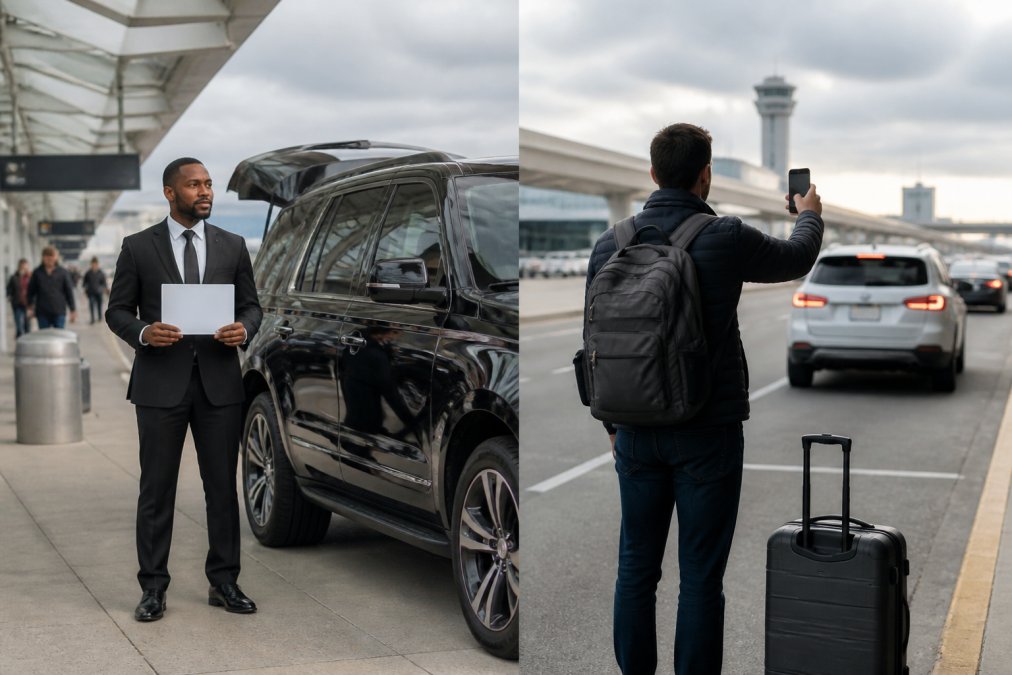
Wait time management is another differentiator. Rideshare drivers at airports operate under platform rules that limit how long they'll wait. Private car services build a defined wait period into the booking, and professional chauffeurs are trained to monitor arrivals and adjust without prompting.
According to FAA air travel data on flight delay patterns, a significant portion of domestic flights experience some form of delay. A ground transportation service that doesn't account for that reality is not a complete solution.
The rideshare model is optimized for availability, not reliability. For everyday airport runs where flexibility is acceptable, that trade-off works. For early-morning departures before an important board meeting, or for picking up a high-value client from an international arrival, reliability is the only metric that matters.
Benefits of Professional Car Service for Executives and Groups
Professional car service is not simply a more expensive version of rideshare. It is a different category of service built around different priorities: punctuality, presentation, discretion, and capacity.
For executive travelers, the practical benefits compound quickly. A chauffeur who knows your schedule, monitors your flight, and has the vehicle ready without a phone call frees up mental bandwidth that matters before a high-stakes meeting. The vehicle itself, maintained to a premium fleet standard, signals professionalism to clients being transported.

Group Travel and Luggage Capacity
Rideshare handles individual travel reasonably well. It handles groups poorly.
Most rideshare vehicles are standard passenger cars with limited cargo space. For a group of six to eight people traveling together, coordinating multiple rideshare vehicles creates scheduling gaps, separate arrival times, and split conversations. The logistics alone become a distraction.
Private car service for groups means a single, appropriately sized vehicle: typically a large SUV or executive van configured for the passenger count and luggage volume. Everyone arrives together, on time, without the coordination overhead.
For corporate golf outings, client hosting events, or team travel to off-site venues, this is not a luxury preference. It is a practical operational requirement. The alternative, splitting a group across multiple app-requested vehicles, introduces the exact kind of friction that professional transport is designed to eliminate.
Privacy, Confidentiality, and VIP Discretion
This is the angle most transportation comparisons skip entirely, and it matters more than people admit.
Rideshare drivers interact with dozens of passengers daily. There is no professional confidentiality standard built into the platform model. Conversations overheard during a ride, high-profile passengers recognized and photographed, or client details inadvertently disclosed represent real exposure for executives and VIP travelers.
Professional chauffeur services operate under a different professional standard. Discretion is not an add-on. It is a baseline expectation, enforced through driver training, professional conduct standards, and the accountability structure of a dedicated service relationship.
For clients who need to know their privacy is protected, the rideshare model simply does not provide that assurance.
Insurance, Liability, and Driver Vetting: The Safety Gap
Passenger safety in ground transportation comes down to two things: who is driving, and what happens if something goes wrong.
Rideshare platforms conduct background checks on drivers, but the standard varies by platform and jurisdiction. Drivers are independent contractors, which creates a more complex liability structure. As noted in NHTSA guidance on passenger vehicle safety standards, regulatory compliance for transportation network companies operates under a patchwork of state-level rules rather than a unified federal framework.
Private car services operate under commercial transportation licensing requirements with more rigorous driver vetting. Background verification for professional chauffeurs typically includes criminal history checks, driving record reviews, and ongoing compliance monitoring. The driver is an employee or contracted professional operating under the service's direct accountability, not an anonymous platform participant.
From a liability standpoint, professional car services carry commercial liability insurance designed for passenger transport. Rideshare drivers operate under a tiered insurance model: personal insurance applies when the app is off, platform coverage applies during active trips, but coverage during the period between accepting a ride and arriving can be ambiguous.
For corporate travel managers and legal teams, this distinction matters. When a company books transportation for executives or clients, the liability exposure of the transport provider is a legitimate risk consideration, not a hypothetical one.
Driver vetting is also where the service experience diverges most visibly. A professional chauffeur is trained in passenger service, vehicle presentation, and professional conduct. Rideshare driver quality is genuinely inconsistent, ranging from excellent to problematic, with no reliable way to predict which you'll get.
Corporate Travel Expense Management and Accessibility
Two angles that rarely get adequate coverage in private car service vs rideshare comparisons: expense management and accessibility.
On the expense side, corporate travel programs benefit structurally from pre-arranged, fixed-rate transportation. Rideshare receipts are generated after the trip, with final amounts that may differ from initial estimates due to surge pricing, wait time charges, or route changes. Reconciling these against travel budgets is an administrative burden that scales with trip volume.
Private car service with corporate account billing provides predictable invoicing, consistent documentation, and the ability to set up recurring arrangements for frequent routes. For finance teams managing travel spend, the difference between a stack of variable rideshare receipts and a structured account with itemized invoices is not trivial.
On accessibility, professional car services can accommodate specific passenger requirements that rideshare cannot guarantee. Travelers with mobility considerations, specific vehicle configurations, or medical equipment needs benefit from a pre-arranged service where requirements are confirmed in advance rather than dependent on which driver happens to be nearby.
Same-day bookings are a common concern for executives with changing schedules. Many professional services, including CLT BLK Truck, accommodate same-day requests when availability allows, though advance booking ensures vehicle and driver assignment. The distinction matters: rideshare offers on-demand availability but no guaranteed service quality, while professional services offer confirmed quality with scheduling that rewards advance planning.
When to Choose Private Car Service vs Rideshare
The decision framework here is straightforward once you strip away the marketing language from both sides.
Choose private car service when:
- The trip involves an airport transfer where on-time performance is non-negotiable
- You are transporting a client, executive, or VIP where presentation and discretion matter
- The group size exceeds what a single rideshare vehicle can accommodate
- Corporate expense reporting requires predictable, fixed costs
- Flight monitoring and adjusted pickup are required
- Privacy and professional confidentiality are expected
- The occasion demands a premium vehicle class and professional presentation
Choose rideshare when:
- The trip is short, spontaneous, and time-flexible
- Cost is the primary consideration and surge pricing risk is acceptable
- No fixed schedule or arrival time is required
- The destination is local and the stakes of a late arrival are low
| Situation | Best Choice | Reason |
|---|---|---|
| Early morning airport departure | Private car service | Guaranteed driver, no cancellation risk |
| Quick lunch run across town | Rideshare | Cost-effective, on-demand |
| Client pickup from airport | Private car service | Flight tracking, professional presentation |
| Group of 8 to corporate event | Private car service | Capacity, single vehicle, punctuality |
| Late-night return from event | Private car service | Reliability, no surge pricing |
| Spontaneous errand, off-peak hours | Rideshare | Speed of booking, acceptable quality |
| VIP or high-profile passenger | Private car service | Discretion, professional conduct standards |
The honest answer is that both services have a legitimate place in a well-managed travel program. The mistake is defaulting to rideshare for situations that require the reliability, accountability, and service standard that only a professional car service provides.
According to Harvard Business Review research on executive productivity and travel friction, reducing logistical friction in high-stakes travel directly correlates with executive performance and decision quality. Ground transportation is not a commodity when the stakes are high enough.
For executives, event planners, and corporate travel managers who cannot afford the unpredictability of surge pricing, driver cancellations, or inconsistent vehicle quality, the case for professional car service is clear. CLT BLK Truck provides executive transport solutions for the Metro Charlotte area, specializing in airport transfers, corporate events, and high-profile occasions where reliability and professional presentation are the baseline, not the upgrade. Get started with CLT BLK Truck to experience ground transportation that removes the uncertainty from your most important trips.
Frequently Asked Questions
Is a private car service more expensive than Uber or Lyft?
A private car service typically costs more than standard rideshare tiers, but the gap narrows during peak travel times when rideshare apps apply surge pricing. With a professional car service, you receive a fixed rate confirmed at booking, so the price you see is the price you pay. For airport transfers, corporate trips, or high-stakes events, that predictability often outweighs a lower base fare that can spike unpredictably.
Is it safer to use a private car service for airport transfers?
Private car services generally apply more thorough driver vetting than rideshare platforms, including background verification, professional licensing checks, and ongoing vehicle maintenance standards. Drivers are employees or contracted professionals, not gig workers who toggle availability between multiple apps. For airport transfers where timing and accountability matter most, a pre-arranged booking with a dedicated chauffeur reduces the risk of last-minute cancellations or unfamiliar drivers.
Do private car services offer flat-rate pricing?
Most professional car services use fixed-rate pricing confirmed at the time of booking. This means no surge pricing during storms, major events, or rush hour. The quoted fare typically covers tolls, wait time allowances, and gratuity, depending on the provider. Contact your car service directly to confirm exactly what is included in your quoted rate before your trip.
When should you choose a private car service over a rideshare app?
Choose a private car service when reliability, privacy, or professionalism is non-negotiable: airport transfers for early flights, corporate client hosting, VIP events, or group travel requiring a larger vehicle. Rideshare apps work well for spontaneous, short trips where cost is the primary factor and the stakes of a cancellation or delay are low. For anything tied to a flight, a meeting, or a high-profile occasion, pre-arranged ground transportation is the lower-risk choice.
Can a private car service accommodate groups traveling together?
Yes. Many professional car services operate SUVs and passenger vans capable of transporting groups of six to ten or more, along with their luggage. This is a clear advantage over standard rideshare options, which are typically limited to four to six passengers per vehicle. For corporate outings, sporting events, or airport group pickups, a single pre-booked vehicle is more efficient and cost-effective than coordinating multiple rideshare rides.
This article was written using GrandRanker